Meton Wallet Review: The Crypto App That Reads an Address's Past Before You Pay
A detailed review of Meton Wallet — the non-custodial multi-chain app from LedgerMind built around pre-transaction fraud screening, and honest about where that protection ends.
By LedgerMind · · 8 min read

Most crypto wallets treat a transaction like a light switch. You paste an address, you confirm, the money goes. What happens next is your problem. Meton Wallet, a non-custodial app from the Wyoming firm LedgerMind, is built around a different assumption: that the second before you tap confirm is the only moment that matters, and that a wallet should spend that second checking who you are actually paying. Whether that idea holds up is the interesting question, so I went through the product in detail.
What it is
Meton is a hot, non-custodial, multi-chain wallet for iOS, Android, and web. Non-custodial means you hold the private keys and LedgerMind cannot reach your funds — the standard that separates a real wallet from an exchange account. Hot means it lives on an internet-connected device, built for spending and receiving rather than deep storage. It handles more than 40 blockchains from a single app — Bitcoin, Ethereum, Solana, Tron, BNB Chain, the main Layer-2 networks, and a long tail beyond — all restorable from one 24-word recovery phrase.
None of that is unusual on its own. Dozens of wallets tick those boxes. The reason to look closely at Meton is a feature the others don't have, and it deserves the bulk of a review.
Security Gate, examined
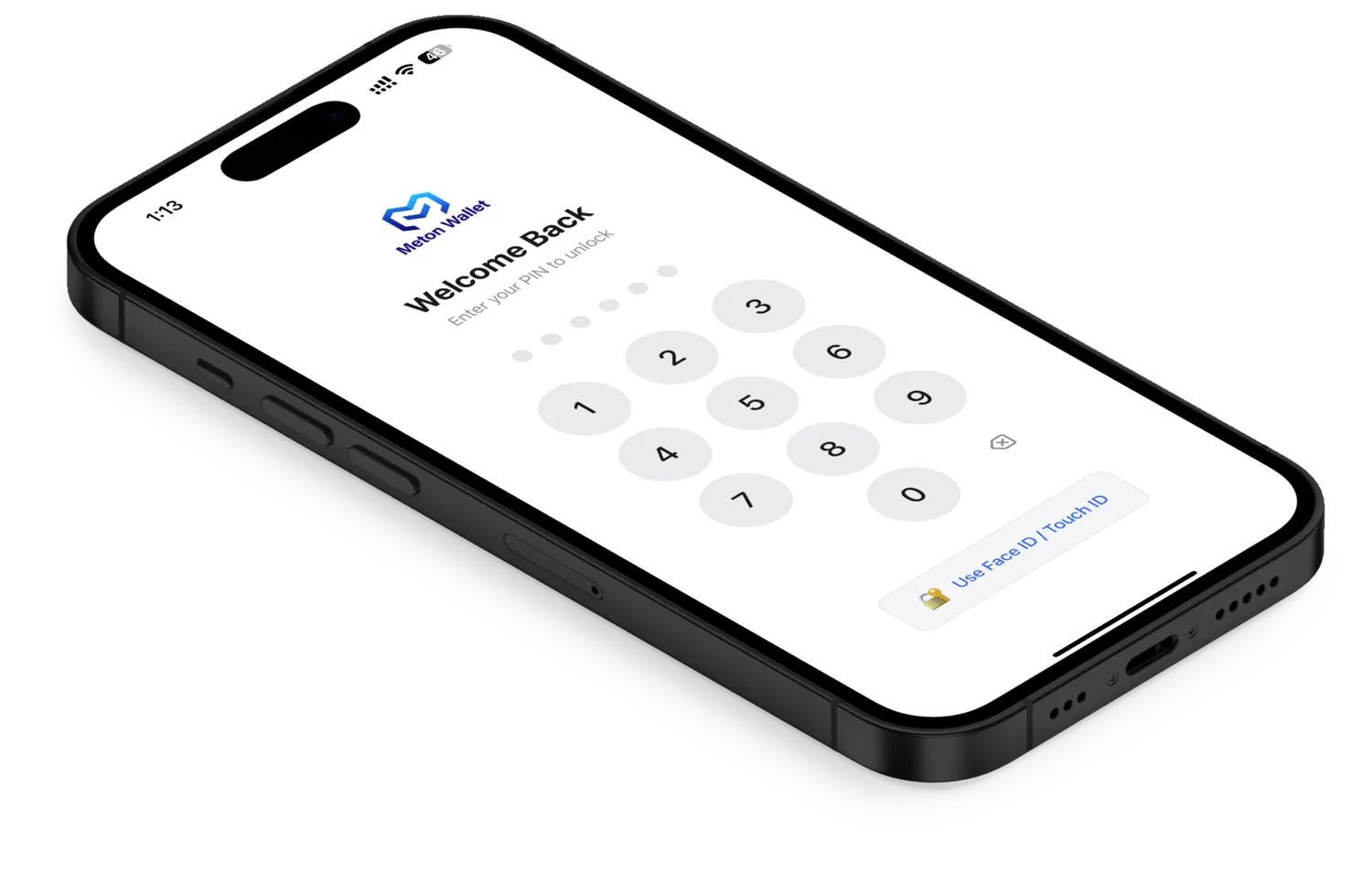
LedgerMind calls it Security Gate, and it runs five checks on every transaction, in parallel, in under a second, then shows you the result before you commit. The framing matters: it informs, it doesn't overrule. You keep the final decision. That is the correct choice, and I will come back to why.
The check that earns the feature its keep is fraud detection. Before a transfer leaves, Security Gate screens the destination against databases of known scam and phishing wallets, stolen-fund addresses, money-laundering patterns, and sanctioned addresses, then returns a verdict in three colours — green for clear, yellow for caution, red for a known-bad address. Crucially, it does the same on incoming funds. The intelligence behind this comes from Tatum.io, a blockchain-security provider that specialises in address risk-scoring. Outsourcing that layer to a dedicated firm is the right call; fraud databases go stale in weeks, and a wallet team trying to maintain its own would lose that race.
Why does pre-transaction screening matter enough to build a wallet around? Because of the way tokens carry their history. On a public blockchain, coins that once passed through a scam, a mixer, or a hacked exchange stay linked to that past, and an exchange's compliance software can trace the connection later — sometimes two or three hops back — and freeze your deposit while you scramble to prove where your money came from. There is a documented case of a user's exchange account frozen because addresses they had paid had themselves touched a laundering wallet. Not their addresses. The ones a step beyond. Security Gate is aimed squarely at that failure. (LedgerMind's own write-up on how frozen funds happen is worth reading alongside this.)
The other four checks are less novel but genuinely useful. Address validation confirms the format, checksum, and correct chain, which kills the most common irreversible mistake in crypto. Contract verification flags cloned or rug-pull tokens. A history check profiles the receiving address by age and activity, catching a dormant wallet that suddenly wakes up. Gas estimation shows the real fee and confirmation time so you are not overpaying. Bundling these into one automatic pass, rather than making the user run a block explorer by hand, is the sort of small design decision that separates a wallet people keep from one they abandon.

The honesty test
Here is where Meton earns some trust, and it is worth dwelling on because the crypto industry rarely does this. LedgerMind's own material states plainly what Security Gate cannot do. It cannot reverse a token freeze imposed by an issuer. If Tether blacklists an address at the contract level — and Tether froze roughly 3.3 billion dollars of USDT across more than 7,200 addresses between 2023 and 2025, according to the forensics firm AMLBot — no non-custodial wallet can override that, Meton included. It cannot promise an address is safe, because a brand-new scam wallet may not be in any database yet. And it has no say over what an exchange does with your funds once they leave.
A product that names its own limits is rarer than it should be, and it makes the claims it does make more believable. A wallet that promised to protect you from everything would be one to distrust.
Under the hood
For readers who care about the plumbing, the custody model uses the BIP39 and BIP44 standards that hardware wallets rely on, a 24-word seed, and AES-256 encryption, with keys held on the device rather than transmitted to LedgerMind. There is no sign-up and no personal data collected, which both improves privacy and shrinks the target on the company's back — a firm that never holds your data can't leak it. You can run several wallets inside the app, each behind its own PIN, which is a tidy way to keep funds from unknown senders quarantined from your main holdings.
The stated stack behind the app is conventional in a reassuring way: React Native and Next.js on the front, NestJS and Node on the back, TLS 1.3 in transit, and Tatum.io plus other providers for blockchain data. Nothing exotic, which for a wallet is a compliment.
What I can't yet judge
A fair review has to mark its own limits too. Three things will only be settled in the wild:
- The security audit. Non-custodial wallets live or die on their key handling, and independent audit results are the evidence that matters. Those need to be public before anyone stores serious money here.
- The false-positive rate. Too twitchy and users learn to click through every yellow warning until the red ones stop registering; too lax and the feature is decoration. That number can't be known until real people move real funds through it.
- Latency under load. “Under a second” in a spec sheet is not the same as under a second on a congested network at peak.
Verdict
The wallet market does not need another app that simply holds keys and shows balances. Meton is worth attention because it does something specific and, as far as I can find, largely unmatched at this tier: it puts an address's history in front of you at the one moment you can still act on it, and it is candid about where that protection ends. The idea is sound, the execution reads as careful, and the honesty is disarming.
I would treat it the way its own design implies — as a daily hot wallet for active use, with real cold storage still holding anything you don't intend to move. On that basis, once the audit is public, it is one of the more thoughtful things to arrive in this crowded category in a while. You can try it at metonwallet.com and judge the screening for yourself; the test that counts is whether it ever stops you from a payment you would have regretted.
Frequently asked questions
Is Meton Wallet safe to use?
Its custody model follows the same BIP39/BIP44 and AES-256 standards hardware wallets use, and keys stay on your device. As with any new wallet, wait for the published independent security audit before storing large balances, and keep long-term holdings in cold storage.
What makes Meton Wallet different from MetaMask or Trust Wallet?
Pre-transaction fraud screening. Meton checks the counterparty address against scam, phishing, stolen-fund and sanctions databases — on both outgoing and incoming transfers — and shows you a green/yellow/red verdict before you confirm.
Is Meton Wallet free?
Yes. There is no sign-up fee and no subscription. You pay only the network gas fees for your transactions, which Security Gate estimates for you up front.
When is the full launch?
LedgerMind targets a full launch around the third quarter of 2026. The app is already published and usable at metonwallet.com.