The Address You Send To Can Freeze Your Money Years Later — Here's How to Stop It
How tainted funds and USDT blacklisting actually work, why self-custody does not save you, and how pre-transaction address screening prevents the freeze before it happens.
By LedgerMind · · 9 min read

There is a myth in crypto that once you hold your own keys, nobody can touch your funds. It is half true. Nobody can move your Bitcoin without your keys. But a lot of what people actually hold isn't Bitcoin — it is USDT, USDC, and other tokens whose issuers can freeze a balance in any wallet, keys or not. And the thing that gets those tokens frozen is often not something you did wrong. It is who you transacted with.
That is the part most people don't see coming. So let us walk through how it actually works, and what a wallet can do about it before the damage is done.
Compliance isn't a corporate word anymore
For years “compliance” was somebody else's problem — the exchange's, the bank's, the regulator's. That changed. Blockchains are public and permanent, which means every address carries its full history forever, and anyone with the right tools can read it. Firms like Chainalysis, Elliptic, and TRM Labs sell exactly those tools, and exchanges, issuers, and law enforcement all use them to score addresses by risk.
Here is what that means for you in practice. When crypto lands in your wallet, it drags its past along with it. If those coins passed through a scam, a mixer, a darknet market, a sanctioned address, or a hacked exchange somewhere back down the chain, your address is now connected to that history. You didn't have to know. The connection is enough.
The tainted-funds trap
The cruelest version of this catches people who did nothing wrong.
Say you sell some crypto peer-to-peer, or accept a payment from a new client, or get paid out from a platform. The funds look fine. They spend fine. Then you try to deposit them to an exchange, and the exchange's monitoring software traces those coins back to an address it has flagged — maybe two or three hops back, to a wallet tied to laundering or theft. Your deposit gets held. Now you are the one writing emails, digging up screenshots, trying to prove where your money came from, while it sits locked.
A user got their exchange account frozen because two of the addresses they had sent USDT to had themselves interacted with a known money-laundering wallet. Not the user's addresses — the addresses one step past them. Proximity was enough.
This is the uncomfortable truth about on-chain compliance: the people most likely to get caught holding tainted funds aren't the criminals, who move fast and cash out early. It is the ordinary users downstream who received money without checking where it had been.
How Tether actually freezes USDT
The on-chain version of a freeze is even more absolute, and USDT is the clearest example. Tether's smart contract has built-in functions with names that tell you exactly what they do: addBlackList, removeBlackList, and destroyBlackFunds. Once Tether adds an address to that blacklist, any attempt to move USDT from it simply fails on-chain. Your wallet still opens. It still shows the balance. The keys are still yours. The tokens just won't move. And with destroyBlackFunds, that balance can be wiped to zero permanently.
Self-custody does not save you here. This happens at the token's contract level, so it doesn't matter whether the USDT sits in a wallet you control or an account you don't. If your address is on the list, the tokens are stuck.
The scale is bigger than most people realize. According to blockchain-forensics firm AMLBot, Tether froze roughly 3.3 billion dollars of USDT across more than 7,200 addresses between 2023 and 2025. Circle froze about 109 million dollars of USDC over the same period — far less, mainly because Circle only freezes on court or sanction orders while Tether acts more proactively. More than half of all frozen USDT, around 1.75 billion dollars, sat on the Tron network, which is cheap and fast and also the favorite rail for scam operations. If you move USDT on Tron, your odds of brushing against a bad address are simply higher.
One more detail worth sitting with. A BlockSec analysis found that most blacklisted addresses had already emptied out before the freeze landed — over half had moved 90 percent or more of their funds. The freeze arrives late for the criminal and on time for whoever they passed the money to. That is the person left holding a locked balance.
Which tokens this hits
Not everything can be frozen, and knowing the difference is worth something.
- Most freezable: centralized stablecoins — USDT, USDC, PYUSD, TUSD, FDUSD — and most fiat-backed tokens have admin freeze functions baked in. Many newer project tokens carry pause or blacklist functions too.
- No issuer freeze: Bitcoin, Litecoin, Dogecoin, and native coins like ETH, SOL, and TRX have no issuer able to blacklist an address — freezing those requires seizing the actual keys.
- The catch: even un-freezable coins can be locked the moment they sit on a centralized exchange, because then the exchange controls the account.
The pattern is consistent: the more useful a token is for everyday payments, the more likely it is that someone, somewhere, can freeze it.
Where Meton Wallet comes in
Here is the honest starting point, because you should be suspicious of any wallet that claims otherwise: no non-custodial wallet can un-freeze a token that Tether has already blacklisted. That power lives in the contract. Anyone who tells you their wallet defeats it is selling you something.
What a wallet can do — and what actually matters, because it is where nearly every avoidable freeze begins — is stop you from touching the risky address in the first place. That is the whole design goal of Meton Wallet's Security Gate.
Security Gate runs an automatic fraud check on every transaction, before you confirm it, and shows you the result in plain language: green means clear, yellow means caution, red means a known scam address. That single check is exactly what would have saved the person in the frozen-account case — a warning about a tainted counterparty before the funds ever moved, instead of a locked account weeks later.
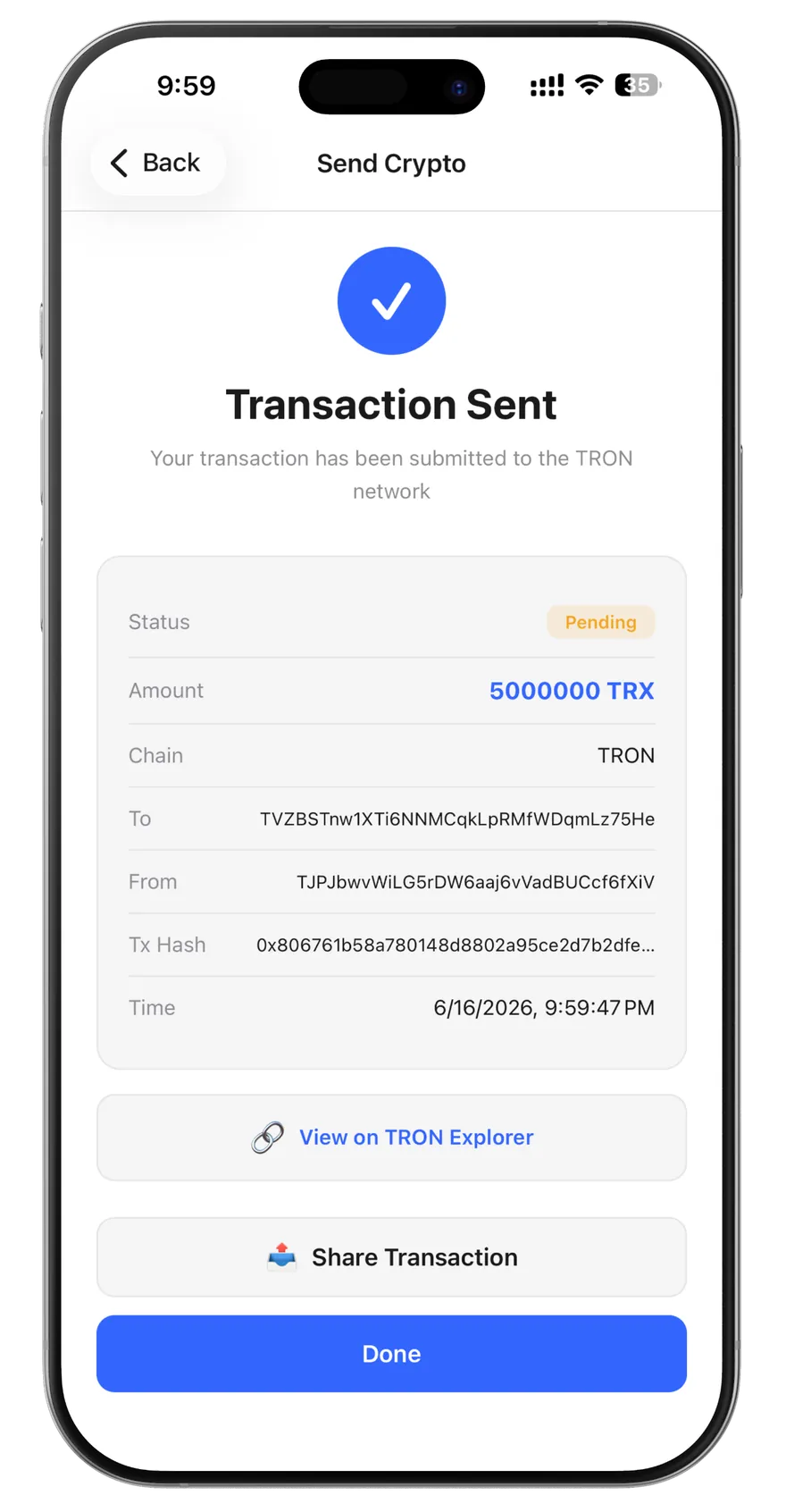
Because the fraud screen is only one of five checks — alongside address validation, token-contract verification, a history check on the receiving address, and a gas estimate — you also get caught before the other common disasters: sending to a malformed address, sending on the wrong chain, or trusting a cloned token contract. All five run at once, in under a second. You still decide. Meton is also non-custodial, so there is no central account for a platform to lock, and you can keep separate wallets inside the app — each with its own PIN — to quarantine funds from unknown senders from your main holdings.
The habit that protects you
Compliance sounds like a burden until you reframe it as a habit that keeps your money movable. Check the address before you send. Know where incoming funds came from before you rely on them. Treat a red or yellow flag as information, not an insult. Meton's Security Gate turns that habit into something automatic, so you are not running manual lookups on a block explorer every time someone hands you an address — the wallet does it in the second before you tap confirm.
Frozen funds are one of the few problems in crypto with no customer-support line and no reversal. The only real fix is not getting into the situation. Check first, then send. Try Meton at metonwallet.com, and if it flags something you would have missed, tell us about it — that is the story we most want to hear.
Frequently asked questions
Can a non-custodial wallet stop my USDT from being frozen?
It can't reverse a freeze once Tether has blacklisted an address — that is enforced in the smart contract. What it can do is warn you before you send to, or accept funds from, the kind of flagged address that leads to a freeze. Prevention is the only real protection.
Why would my exchange freeze a deposit if I didn't do anything wrong?
Exchange compliance software traces the history of the coins you deposit. If those coins passed within a few hops of a flagged wallet — a scam, a mixer, a laundering address — the exchange may hold the deposit until you can prove the source of funds, even though you never interacted with the bad address directly.
Is USDT on Tron riskier than on Ethereum?
Statistically, yes. Around 1.75 billion dollars of the USDT Tether froze between 2023 and 2025 was on Tron, which is a common rail for scam operations. Screening the counterparty address matters more there, not less.
Which coins cannot be frozen by an issuer?
Bitcoin, Litecoin, Dogecoin, and native network coins such as ETH, SOL, and TRX have no issuer that can blacklist an address. They can still be locked if they are sitting in a centralized exchange account.